Publised on May 23, 2026
Patent Drawings: The Line That Defines Protection
Team VV Research IP
In patents, language builds the argument.
But drawings? They settle it.
At VV Research IP, we often see a gap, not in innovation, but in how that innovation is presented. And nowhere is this more evident than in patent drawings.
Because the truth is simple, and often overlooked:
A patent is not just what you write.
It is what the examiner can clearly understand: instantly.
Drawings: The Silent Backbone of a Patent
Patent drawings are not supplementary. They are foundational.
They:
Translate complexity into clarity
Bridge technical gaps in written descriptions
Define the boundaries of your invention visually
A well-drafted figure can eliminate pages of explanation.
A poor one can create confusion that no wording can fix.
India vs The Global Approach
There is a noticeable philosophical difference in how drawings are approached.
In India, many filings still treat drawings as procedural, necessary, but secondary.
Globally, that mindset doesn’t survive scrutiny.
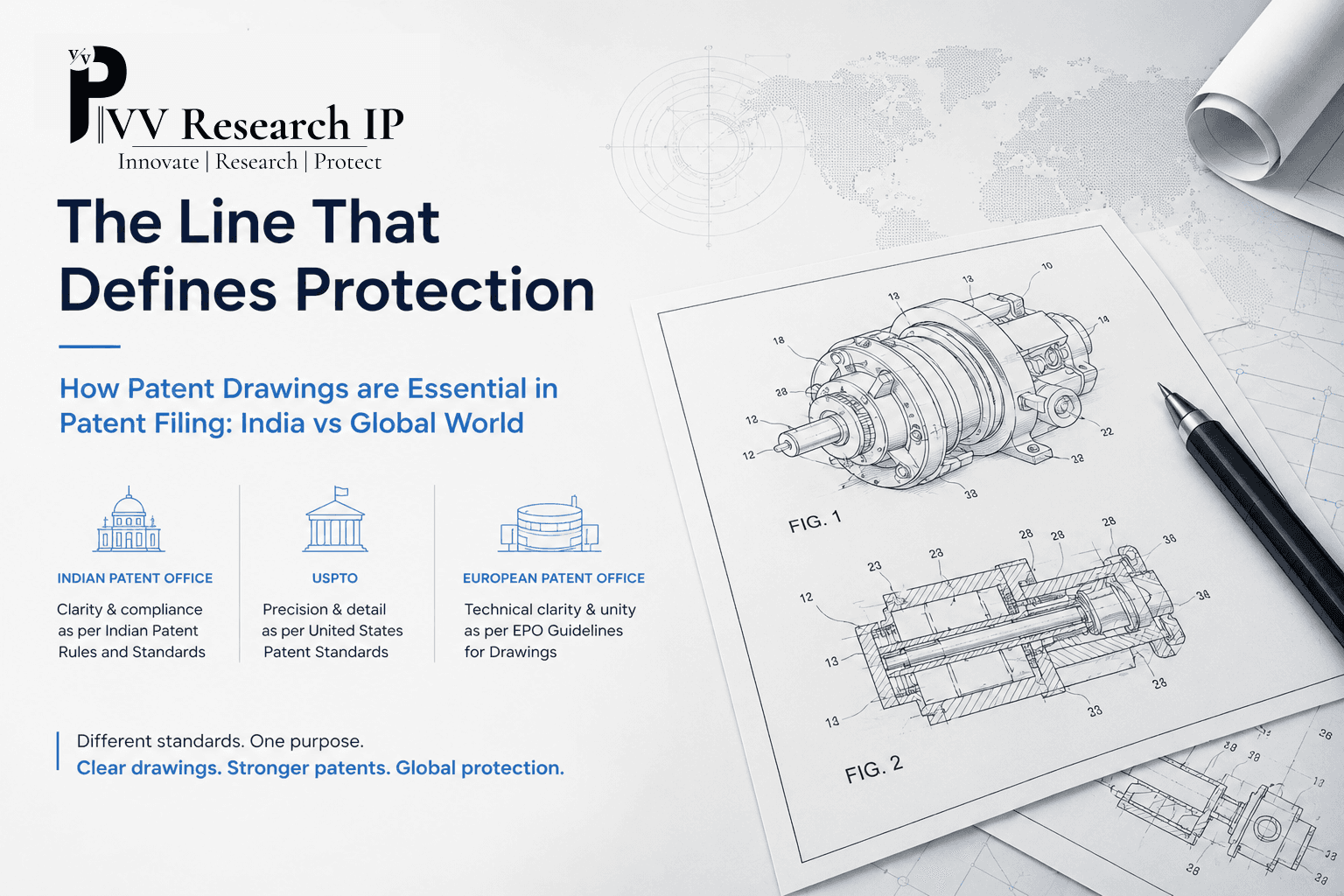
Indian Patent Office (IPO)
The Indian Patent Office requires drawings where necessary to understand the invention. They must follow formal standards, clear black lines, no shading, proper numbering, margins, and consistency with the specification.
But here’s the nuance:
While compliance is enforced, strategic depth in drawings is often underutilized.
Which means many patents are acceptable, but not optimal.
USPTO (United States Patent and Trademark Office)
The USPTO takes drawings far more seriously as a matter of examination.
Their requirements are strict:
Precise line quality and uniformity
Reference numerals tightly linked to the specification
Multiple views (perspective, sectional, exploded) where needed
Strict prohibition of ambiguity
But more importantly, in the US:
Drawings are used actively to interpret claims.
A well-prepared drawing can:
Strengthen claim breadth
Prevent examiner misinterpretation
Support arguments during prosecution
In many cases, US patents succeed or fail not just on claims, but on how clearly the invention is shown.
European Patent Office (EPO)
The European Patent Office operates with a precision-first philosophy.
Their drawing standards emphasize:
Absolute clarity and reproducibility
Consistency across all figures
No unnecessary artistic elements, only functional depiction
But here’s where Europe stands apart:
The EPO values drawings as part of the technical disclosure itself.
This means:
Drawings can directly influence how inventive step is assessed
They play a role in defining what is actually disclosed at the filing date
In other words, if it’s not clearly shown, it may not be considered fully disclosed.
Why This Difference Matters
In today’s world, patents are rarely local.
A startup filing in India today is thinking globally tomorrow.
And that’s where the risk emerges.
A drawing that passes in India might:
Face objections in the US
Be considered insufficient in Europe
Limit claim interpretation across jurisdictions
This creates a hidden problem:
You don’t lose your invention.
You lose the strength of its protection.
The Strategic Advantage
When drawings are treated as strategy, not compliance; they become powerful.
They can:
Anticipate examiner objections before they arise
Expand the perceived scope of claims
Improve enforceability across jurisdictions
Make your patent more defensible in litigation
Most importantly, they create clarity at first glance, and in patent examination, that’s everything.
The Shift We Advocate at VV Research IP
We approach patent drawings the same way we approach IP strategy:
Deliberately. Globally. Precisely.
Because if your ambition is global, your documentation must be too.
A Thought to Leave You With
Words can be argued.
Lines cannot.
In the end, a patent is not just a legal document,
it is a visual contract of your innovation with the world.
And sometimes, the strength of that contract
comes down to how clearly you draw the line.